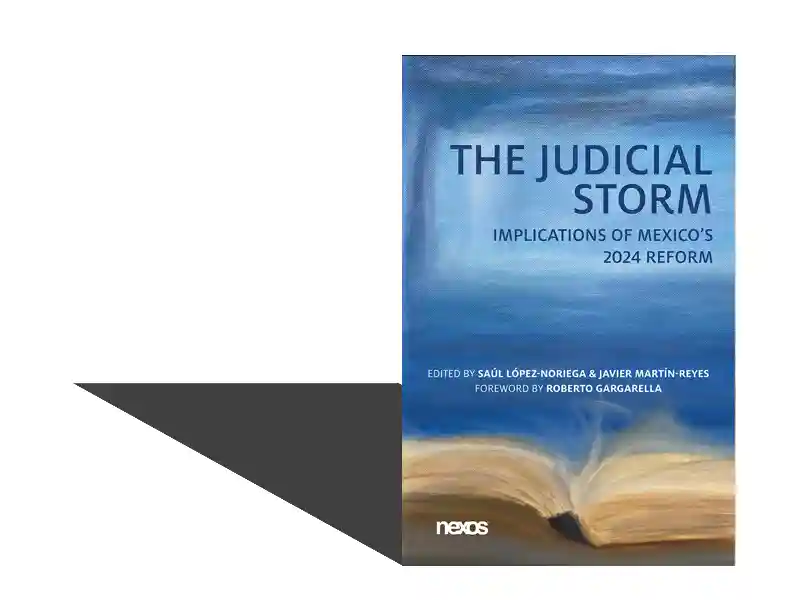
The constitutional reform of 2024 represents the most significant change to the judiciary in Mexico’s history. Its implications are extensive. All federal and state judges will be replaced within less than three years. New judges will be elected through a popular voting process, which is unprecedented globally. Additionally, important mechanisms for protecting rights, such as the amparo lawsuit—Mexico’s primary judicial tool for safeguarding constitutional rights—will be notably weakened.
In light of such a significant change, the works presented in this book clearly explain the reform’s content, making it accessible to a broad audience that may not be well-acquainted with the Mexican justice system. Addition ally, these works offer insights into the potential impact of this constitutional change. We believe that such a complex and radical reform requires careful and thorough analysis.
We know that this reform will unleash a genuine storm within the judicial system. Simultaneously, we recognize that the exact consequences cannot be predicted with certainty. Just like real storms, uncertainty is inherent to their nature. Keeping this in mind, the aim of this book is to provide an initial analysis of the most probable effects of this radical transformation of the Mexican justice system. The ultimate effects will only become clear over time. We therefore hope that this work will serve as a foundation for future research examining how the changes introduced by this constitutional reform will manifest in practice in the medium and long term.
This book brings together the work of a group of specialists in the Mexi can judicial system. Based on solid arguments and empirical evidence, these analyses provide a comprehensive overview of the most plausible scenarios that could arise when this storm hits Mexico’s complex and diverse social conflicts. In this context, it is essential to emphasize that the impact of the reform is not limited to the popular election of judges. The reform is much broader and more complex, as it reshapes fundamental aspects of both the Federal Judiciary and the state judicial branches. The book examines the major changes in the structure and operation of the courts that extend beyond the election of judges. It also explores what these changes could mean for various stakeholders, from the most vulnerable populations to businesses and investors operating in the country.
In this introductory chapter, we present a general explanation of the origins and content of the 2024 judicial reform. Understanding its scope necessitates knowledge of the context in which it was conceived. Therefore, the subsequent section reviews previous judicial reforms and their implementation. A decisive turning point occurred in 1994, when a reform was enacted to align the Federal Judiciary with the principles of constitutional democracy and overcome the role that the judiciary had played under the authoritarian regime that ruled Mexico for 70 years.
The second part of this chapter focuses on the tensions that emerged during the López Obrador administration (2018-2024) between the executive and legislative branches, on one side, and the judiciary, on the other. Specifically, we examine how the judicial reform bill introduced in 2024 represented the culmination of a six-year term characterized by conflicts between the judiciary and López Obrador’s movement.
Finally, we provide a brief overview of the chapters in this book, ex-plaining the reasons for their inclusion and describing their main arguments, contributions, and findings.
[…]
The book contains twelve more essays, along with this chapter, collectively providing a thorough and detailed examination of the key elements of the Obrador-Sheinbaum judicial reform and its potential impacts once fully enacted. The consensus from these essays is unmistakable: the judiciary is confronting a perfect storm.
In Chapter 2 (Are Judicial Elections in the United States Comparable to the Popular Vote Established by the Mexican Judicial Reform?), Francisca Pou Giménez explains the confusion about the judicial election model in various U.S. states and its comparison to Mexico’s newly adopted judicial electoral system. She illustrates that the disparities are significant and stresses the need to point out their incompatibilities to prevent misleading or deceptive comparisons.
In Chapter 3 (Judicial Elections in Mexico: The Risk of Capture), Guadalupe Salmorán-Villar highlights a key aspect of the Mexican system of judicial popular elections: the substantial role and influence of political entities during the entire process. This situation leads to a heightened focus on political allegiance rather than technical qualifications in the selection and appointment of judges, potentially undermining the judiciary’s neutrality and independence.
In Chapter 4 (The Key to the Judicial Branch Election: The Allocation of Positions by Districts), Alonso Zepeda Celis tackles an important issue: conflating electoral districts with judicial districts, even though they follow distinct principles. Electoral districts are based on population, while judicial districts are defined by the subject matter of disputes in a specific area. The central issue is the erosion of citizens’ voting power—either their votes lack equivalent weight, or they cannot elect all the judges who will influence their lives.
In Chapter 5 (The Judicial Career after Obrador-Sheinbaum’s Reform), Andrea Pozas Loyo and Julio Ríos Figueroa explore the effects of abolishing the judicial career path. Their findings are notably discouraging: the dismantling of the judicial career undermines the establishment of a professional cadre of judges who possess a strong understanding of the law and le- gal precedents while failing to create suitable incentives to attract individuals to careers in justice institutions.
In Chapter 6 (The Other Side of the Reform: The New Discipline and the Same Administration of the Federal Judiciary), Alfonso Oñate Laborde explores a crucial change brought about by the judicial reform: the replacement of the Federal Judiciary Council with the Court of Judicial Discipline and the Judicial Administration Body. These new institutions have stirred controversy due to their significant power, the lack of legal recourse against their decisions, and—particularly concerning the Court of Judicial Discipline—the fact that their members are elected by popular vote, raising concerns about the potential for political capture.
One key issue that has been largely overlooked is the role of substitute judges: What procedures are in place if a judge is permanently absent? Is there a need for a new electoral process? In Chapter 7 (The Replacement of Elected Judges), Sergio López Ayllón offers thorough responses to these seemingly minor questions, which are actually critical to fulfilling a promise of judicial reform: ensuring that the popular vote for judicial appointments is genuine and that it is effectively regulated in situations of voluntary or involuntary absences.
The following three chapters offer a well-rounded view of how judicial reform affects the jurisdictional arena. In Chapter 8 (The End of General Effects in Mexico’s Constitutional Justice), José María Lujambio clearly explains the implications of eliminating the possibility for courts to issue general injunctions—temporary orders that halt the application of challenged laws or government acts not just for the claimant, but for society at large. He also analyzes the consequences of restricting amparo rulings (Mexico’s primary constitutional relief mechanism) from having general effects, meaning that their legal impact is confined to individual claimants, even when the underlying norm is found to be unconstitutional. Chapter 9 (Constitutional Justice Adrift: The Elimination of the Chambers of the Supreme Court), by José Omar Hernández Salgado and Mariana Velasco Rivera, presents empirical data illustrating the chaotic consequences stemming from the dissolution of the Supreme Court’s chambers (salas). This change compels the Court to handle the thousands of cases it encounters annually through a singular entity: the full bench (Pleno). In Chapter 10 (Case Law and the System of Precedents: Scenarios Following Judicial Reform), María Amparo Hernández Chong Cuy adeptly articulates, with a pedagogical approach, the impact of judicial reform on the precedent framework and the associated risk of political influence over judicial rulings by the Supreme Court.
In Chapter 11 (The Other Judicial Reform: What’s Happening in Mexico’s States), Javier Martín-Reyes and Saúl López-Noriega explore a judicial reform element that has largely been overlooked in public discussions: the state judiciaries. This aspect is so crucial that it can be considered a distinct reform in its own right. The chapter examines the effects of this reform at the most critical level of justice regarding social conflict and its implications for the daily lives of the country’s citizens.
Chapter 12 (Faceless Judges), by Rodrigo Brito Melgarejo, explores this figure as both a public policy reflecting the shortcomings of recent Latin American experiences and through the critical lens of the Inter-American Human Rights System. Chapter 13 (Beyond the Judicial Election: The New Mexican State) by Daniel Quintanilla Castro concludes the book, linking judicial reform with other institutional changes driven by the current populist government in Mexico, including preventive detention and militarization, which are part of Plan C. As we’ve argued elsewhere, these reforms are collectively giving rise to a new Mexican state—one that is more authoritarian, more autocratic, more militarized, and more punitive.1
Saúl López-Noriega. Professor and researcher at the School of Government and Public Transformation of the Monterrey Institute of Technology and Higher Education (ITESM).
Javier Martín-Reyes. Law professor and researcher at the Institute for Legal Research of the National Autonomous University of Mexico (IIJ-UNAM) and nonresident scholar at the Center for the U.S. and Mexico of Rice University’s Baker Institute.
* Note: We thank Luis Mauricio Varas Silva and Gadiel Solorio Alvarez for their support as research assistants.
Available in
 |
 Apple Books |
1 Saúl López Noriega and Javier Martín Reyes, “En el umbral de la autocracia,” Nexos, Mexico, November 2024.